What is an all-in-one business platform (and do I actually need one)?
Updated 4 August 2026 by Chantal Edouard-Betsy.
An all-in-one business platform is one system that runs the jobs you are currently paying five or six separate tools to do: your website, your email, your CRM, your courses, your calendar, your payments and your automations, under one login. The real question is not what it is, though. It is whether you actually need one, or whether your current setup is fine and a move would be effort for its own sake. Let me give you an honest answer to both, including who should not bother.
Quick answer: An all-in-one business platform is a single system that replaces the separate tools you would otherwise stitch together: website and funnels, email marketing, CRM and pipelines, online courses, calendars and bookings, payments, and automations, all under one login and one bill. You need one if your tools do not talk to each other, you are the human copy-pasting between them, and leads or clients slip through the cracks. You probably do not need one if you sell one simple thing, your current setup works, and nothing is falling over. I am Chantal Edouard-Betsy, founder of heyCEOflow, an all-in-one platform for founders who are the face of their brand. The honest test is not the feature list. It is whether your stack is costing you time, money and dropped leads right now.
Most people ask this question a bit wrong. They ask "which all-in-one platform is best," when the first question is whether they are the kind of business that benefits from one at all. Get that right and the choice gets much easier.
In this blog
- What an all-in-one platform actually is
- Who genuinely needs one
- Who does not need one (yet)
- A quick check: is your stack costing you?
- Where heyCEOflow fits
- FAQ
- Key takeaways
What an all-in-one platform actually is
Think about everything a small business runs on. A website. An email list and the software that sends to it. A CRM to track leads. Maybe a course or a membership. A calendar for bookings. A checkout for payments. And the automations that connect all of that, so a new lead gets a reply, a booking, an invoice and course access without you doing each step by hand.
In a typical setup, that is six or seven separate tools, each with its own login, its own bill, and its own idea of how things should work. An all-in-one platform is one system that does all of those jobs itself, so the pieces are already connected because they were built to live together. One login. One subscription. One place where your business actually runs.
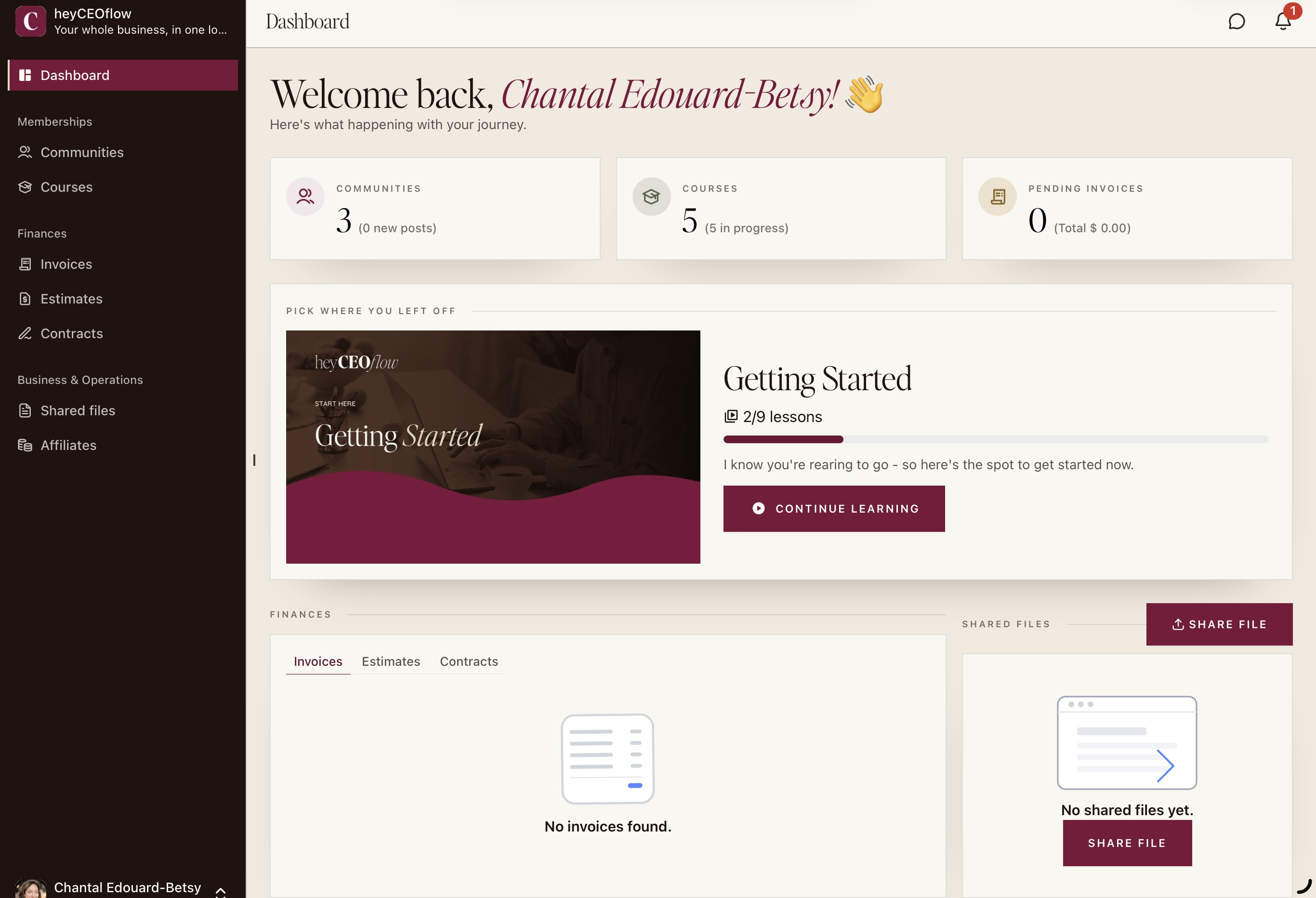
The all-in-one client portal is a good example of the difference. Instead of a course tool here and a payment link there, your client logs into one branded home for their courses, invoices and bookings. (Here is how that portal works, and how to brand it.)
Who genuinely needs one
The founder this suits is usually drowning in a stack that does not talk to itself. You know the feeling. A lead comes in on one tool, you copy them into another to email them, you manually send a booking link, you chase the payment somewhere else, and every handoff is you, by hand, in the gaps between actual work.
That is the exact pain an all-in-one solves. When the tools are one tool, the handoffs happen on their own. The lead gets the email, the booking, the invoice and the access without you being the glue. If you are the person currently being the glue, and leads or clients are slipping through the cracks because a handoff got missed, you are who this is for.
It suits you especially if you are the face of your brand, a coach, consultant, creator or practitioner, where the client experience is part of the product and a scattered, clunky backend leaks the trust your brand works hard to build.
Who does not need one (yet)
Here is where I lose some sales, because I would rather you not move than move for the wrong reason.
If you sell one simple thing, a single low-maintenance offer, and your current setup works and nothing is falling over, you do not need to consolidate anything. Do not fix what is not broken. If you are mid-launch, do not move platforms in the middle of it, ever. And if you built your current setup eight weeks ago and it is fine, sit with your own decision a while longer before you tear it up.
An all-in-one platform earns its place when the scatter is genuinely costing you. If it is not costing you, it is not urgent, and that is a perfectly good answer.
A quick check: is your stack costing you?
Run this honestly. Answer yes or no.
- Are you paying for tools you have not opened this month?
- Do you regularly copy information from one tool into another by hand?
- Has a lead or client ever slipped because two tools did not talk?
- Could you say, off the top of your head, what your tools cost you in total each year?
If you are paying for things you do not use, being the glue by hand, losing the odd lead to the gaps, and you cannot name your total spend, your stack is costing you more than money. It is costing you the time and the head space of running six systems instead of one. That is the point an all-in-one starts to pay for itself. If your business is more clutter than system right now, this piece on decluttering your online business is a good next read.
Where heyCEOflow fits
heyCEOflow is my all-in-one platform, built for founders who are the face of their brand rather than for agencies. Your site, email, CRM, courses, calendar, payments and automations run in one place, under one login, so your business stops being a pile of tools and starts being a system.
There are two ways in. heyCEOflow LITE, at $197 a month, to get your core off the scattered tools and under one roof. And heyCEOflow PRO, at $297 a month, when you are running more and want the lot. You can start lean and grow into it.
FAQ
What is an all-in-one business platform?
It is a single system that runs the jobs you would otherwise split across separate tools: website and funnels, email marketing, CRM, online courses, calendars and bookings, payments, and automations. Because the parts are built to work together, they are already connected, so you manage one login and one subscription instead of stitching several tools together.
Do I really need an all-in-one platform?
You need one if your tools do not talk to each other, you are manually moving information between them, and leads or clients slip through the gaps. You probably do not if you sell one simple offer, your current setup works, and nothing is failing. The test is whether the scatter is genuinely costing you time, money or dropped leads.
What does an all-in-one platform replace?
Typically your separate website builder, email marketing tool, CRM, course or membership host, calendar and booking tool, checkout, and the automation tool connecting them. One platform does those jobs itself, which is why the pieces are already connected rather than held together by you.
Is an all-in-one platform cheaper than separate tools?
Often, once you add up every subscription you are currently paying, though the bigger saving is usually time rather than money. The point is not only the monthly cost. It is the hours lost being the manual link between tools, and the leads lost when a handoff is missed.
Who should not switch to an all-in-one platform?
Anyone selling one simple thing whose current setup works, anyone mid-launch, and anyone who just built their current setup and is second-guessing it too soon. If nothing is falling over, consolidating is not urgent, and moving for its own sake is effort without a payoff.
Is HighLevel an all-in-one platform?
Yes. HighLevel is an all-in-one platform, and heyCEOflow is built on the HighLevel engine, packaged for founders who are the face of their brand rather than for agencies. It runs your site, email, CRM, courses, calendar, payments and automations under one login.
Key takeaways
- An all-in-one platform is one system that runs your website, email, CRM, courses, calendar, payments and automations under one login, instead of six or seven separate tools.
- You need one if you are the manual glue between tools and leads slip through the gaps.
- You do not need one if you sell one simple thing, your setup works, or you are mid-launch. Do not move for its own sake.
- The honest test is whether your scattered stack is costing you time, money and dropped leads right now.
- heyCEOflow is an all-in-one platform for face-of-brand founders, from $197 a month on LITE.
Ready to run on one platform instead of six?
If your stack is costing you and you would rather run your business as one system, heyCEOflow brings it all under one login. Start lean on LITE at $197 a month and grow into PRO when you need more. Have a look and see if it fits.


